
Joints & Inflammation
Stiff, aching joints are linked to accumulated ama (metabolic residue) and dryness. Warm oils, anti-inflammatory spices and gentle daily movement are the core response.
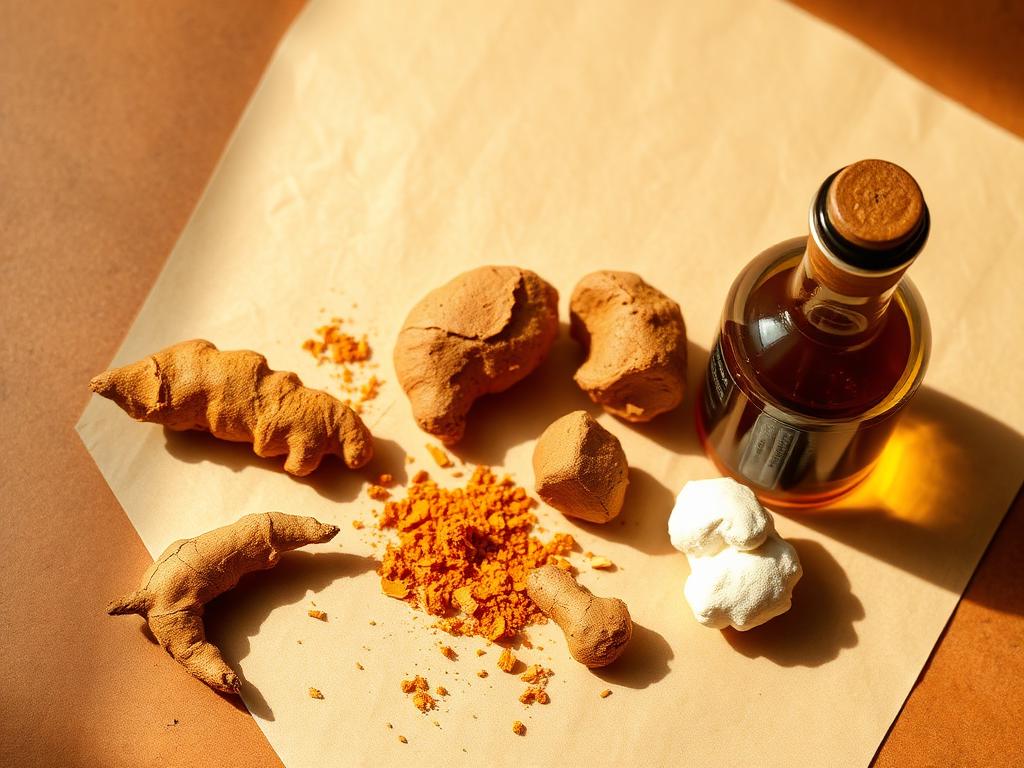
Daily practice
- Warm oil massage on affected joints followed by mild heat
- Daily gentle mobility rather than occasional intense training
- Reduce cold, raw and fermented foods during flare-ups
Herbs used for Joints & Inflammation
Turmeric
Curcuma longa
The everyday anti-inflammatory root of the kitchen pharmacy.
- Plant
- Turmeric plant · Herb
- Also
- Haldi, Haridra, Manjal
- Parts
- Rhizome (root)Fresh root
Ginger (Ginger / Dry Ginger)
Zingiber officinale
Called vishwabhesaj, the universal medicine, for good reason.
- Plant
- Ginger plant · Herb
- Also
- Adrak, Ardraka, Shunthi (dried)
- Parts
- Rhizome (root)
Guggul (Indian Bdellium Resin)
Commiphora mukul
Resin used for stiff joints and sluggish metabolism.
- Plant
- Guggul tree · Resin
- Also
- Indian bdellium, Guggulu, Mukul myrrh
- Parts
- Gum resin from bark
Harsingar (Night-Flowering Jasmine)
Nyctanthes arbor-tristis
Night-flowering jasmine, also called harshringar: leaf juice used for joints and fever.
- Plant
- Harsingar tree · Tree
- Also
- Harshringar, Night-flowering jasmine, Parijat, Shefali
- Parts
- LeafFlowerBarkSeed
Eucalyptus (Eucalyptus / Blue Gum)
Eucalyptus globulus
Sharp, camphor-like leaf used in steam and chest rubs to open blocked breathing.
- Plant
- Eucalyptus tree · Tree
- Also
- Nilgiri, Blue gum, Tailaparna, Gum tree
- Parts
- LeafLeaf oil
Punarnava (Spreading Hogweed)
Boerhavia diffusa
"That which renews" — the classic herb for fluid retention and puffiness.
- Plant
- Punarnava creeper · Herb
- Also
- Hogweed, Spreading hogweed, Santhi, Gadahpurna
- Parts
- RootLeafWhole plant
Stinging Nettle
Urtica dioica
Mineral-rich spring green used as a gentle cleanser for joints, skin and urine flow.
- Plant
- Stinging nettle plant · Herb
- Also
- Common nettle, Bichhu buti, Sisnu, Kandali
- Parts
- LeafRootSeed
Barley
Hordeum vulgare
The classical Ayurvedic grain — light, drying and cooling for water retention and heat.
- Plant
- Barley grass (cereal grain) · Herb
- Also
- Yava, Jau, Pearl barley, Barley grass
- Parts
- GrainSproutGrass
Moringa (Drumstick Tree / Moringa)
Moringa oleifera
The drumstick tree — leaf powder dense in iron, calcium and protein, used for depletion and anaemia.
- Plant
- Drumstick tree · Tree
- Also
- Drumstick tree, Shigru, Sahjan, Horseradish tree
- Parts
- LeafPodSeedBark
Giloy (Heart-Leaved Moonseed)
Tinospora cordifolia
The 'nectar creeper' — the classical immunity and fever herb of Ayurveda.
- Plant
- Giloy creeper · Climber
- Also
- Guduchi, Amrita, Heart-leaved moonseed, Gurjo
- Parts
- StemLeafRoot
Black Pepper
Piper nigrum
The king of spices — kindles digestive fire and carries other herbs deeper into the body.
- Plant
- Pepper vine · Climber
- Also
- Kali mirch, Maricha, Peppercorn
- Parts
- Fruit (peppercorn)
Kava Kava (Kava Kava Root)
Piper methysticum
Pacific root for deep calm, muscle relaxation and social ease.
- Plant
- Kava kava shrub · Shrub
- Also
- Kava, Piper methysticum, Awa
- Parts
- RootRhizome
Black Cherry (Black Cherry Bark)
Prunus serotina
Astringent bark for dry coughs, joints and settled digestion.
- Plant
- Black cherry tree · Tree
- Also
- Wild black cherry, Chokecherry, Prunus serotina
- Parts
- BarkFruit
Boswellia (Boswellia / Frankincense)
Boswellia serrata
Indian frankincense resin for joints, lungs and gut comfort.
- Plant
- Boswellia tree · Tree
- Also
- Indian frankincense, Salai guggal, Olibanum
- Parts
- Gum resinBark
Pippali (Long Pepper / Pipal)
Piper longum
Long pepper for respiratory congestion, sluggish digestion and deep tissue warmth.
- Plant
- Long pepper vine · Climber
- Also
- Long pepper, Pipal, Thippili, Magadhika
- Parts
- FruitRoot
Common questions
Which herbs are traditionally used for joints & inflammation?
Classical and modern sources point to Turmeric, Ginger, Guggul, Harsingar, Eucalyptus. Each herb page lists dosage, preparation, timing and precautions.
Are there recipes for joints & inflammation?
Yes — 6 kitchen preparations are grouped under this concern, each with ingredients, steps, timing and safety notes.
How are herbs used for joint comfort — internally or externally?
Both. Turmeric and boswellia are taken internally with a fat or black pepper for absorption, while medicated oils are massaged warm into the joint and followed by gentle movement.
How long before joint support is noticeable?
Traditional use assumes four to eight weeks of daily intake, with warmth, movement and weight management doing as much work as the herbs.
Who should avoid anti-inflammatory herbs?
Anyone on blood thinners, planning surgery, pregnant, or with gallstones or active ulcers should get medical clearance first — turmeric and boswellia are the usual concerns.